


Own an Andy Warhol Cowboys and Indians print? The 1986 portfolio includes John Wayne, Annie Oakley, Geronimo and seven other subjects. This guide illustrates the ten portfolio prints and explains the related trial proofs, edition markings and condition details that matter when selling.
Our gallery offers a free, confidential valuation of individual Cowboys and Indians prints and complete portfolios. Send photographs and any available ownership records to discuss your work and a potential direct purchase offer.
Request a Cowboys and Indians Valuation
The 1986 Cowboys and Indians portfolio
The regular Cowboys and Indians portfolio comprises ten screenprints, catalogued as Feldman & Schellmann II.377–386. Four additional subjects were developed as trial proofs. This distinction explains why some references to the wider project show fourteen images.
1986 · Gaultney, Klineman Art, Inc., New York
Screenprint on Lenox Museum Board
Approximately 36 × 36 in.
(91.4 × 91.4 cm) per sheet
250, plus 50 artist’s proofs
Ten prints · F&S II.377–386
The portfolio was printed by Rupert Jasen Smith, New York. Catalogued sets have pencil signatures and edition markings, printer’s blindstamps and publisher’s stamps. Some John Wayne impressions are inscribed “UNIQUE”, a documented feature discussed below.
Edition reference: catalogued complete Cowboys and Indians portfolio. Measurements refer to the sheet and can vary slightly between impressions.
History, Hollywood and the American West
One of Warhol’s last major print portfolios, Cowboys and Indians places film celebrity, historical portraits and Native American cultural objects within the same visual framework. The Hood Museum discusses the series in relation to westward expansion, representation and the romanticized images through which American history circulates. The subject titles below follow the published catalogue.
The ten Cowboys and Indians portfolio prints
Use the subject and catalogue number to identify your composition. The F&S reference identifies the work; it is different from the impression’s edition number. Trial proofs can use alternate color combinations.

F&S II.377

F&S II.378

F&S II.379

F&S II.380

F&S II.381
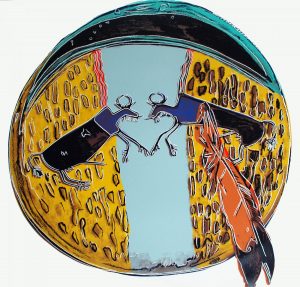
F&S II.382
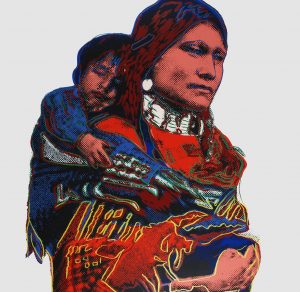
F&S II.383

F&S II.384
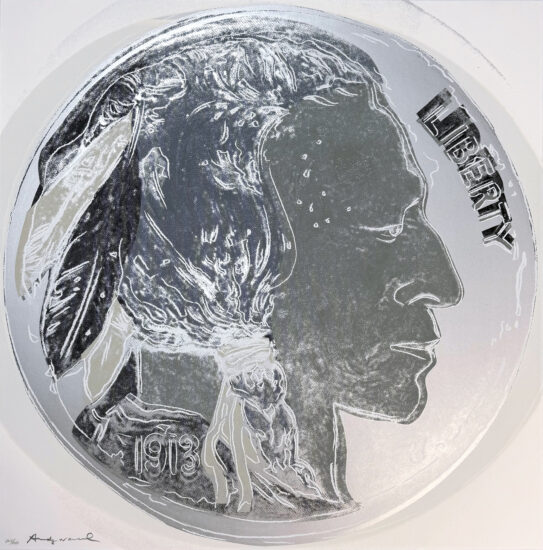
F&S II.385

F&S II.386
Signatures, John Wayne variants and trial proofs
Signed and numbered impressions
Published edition examples are signed and numbered in pencil near the lower edge, with the location varying by subject. Photograph the autograph, numbering and any proof designation, along with the printer’s blindstamp and accessible stamps or labels on the reverse.
For example, F&S II.384 identifies Geronimo, while 17/250 identifies an impression from the numbered edition. A.P. indicates an artist’s proof; the portfolio includes 50 artist’s proofs alongside the edition of 250. Other documented proof and Roman-numeral designations should be recorded exactly as they appear.
Why is John Wayne sometimes marked “UNIQUE”?
John Wayne impressions inscribed “UNIQUE” appear in documented complete portfolios. Christie’s explains that some impressions were rescreened with variations and their original numbering replaced by this inscription. It is a specific feature of the John Wayne publication history and does not, by itself, identify a trial proof.
See the catalogue explanation of the John Wayne inscription. Include clear photographs of any remaining number, inscription and reverse markings when requesting a valuation. The word “UNIQUE” alone does not establish authenticity.
Trial proofs: T.P.
The project includes trial-proof editions of 36 in unique color combinations. Trial proofs exist for subjects in the ten-print portfolio and for four additional compositions. A catalogued Geronimo trial proof, for example, is inscribed T.P. 24/36.
A different palette can be consistent with a trial proof, but the proof inscription, printing, board and provenance must be reviewed together. Proof status does not automatically mean a higher value.
The four additional trial-proof subjects
These compositions belong to the wider Cowboys and Indians project and are outside the regular ten-print portfolio:
- War Bonnet Indian — F&S IIB.373
- Buffalo Nickel — F&S IIB.374
- Action Picture — F&S IIB.375
- Sitting Bull — F&S IIB.376
The Hood Museum records signed trial proofs of War Bonnet Indian, Action Picture and Sitting Bull, each numbered out of 36. Buffalo Nickel is also documented as a unique color trial proof. Send photographs if you own one of these subjects.
What affects the value of a Cowboys and Indians print?
A useful valuation starts with the subject and exact edition or proof type. A numbered portfolio sheet, a John Wayne variant and a unique color trial proof require different comparisons.
- Subject and edition: catalogue reference, numbered edition or proof designation, and the documented color combination.
- Printed surface: fading, scuffs, scratches, rubbing, ink losses, cracking, retouching and restoration.
- Board and edges: stains, creases, corner damage, trimming, mounting adhesive and damage concealed by a frame.
- Signature and provenance: the autograph, numbering or inscriptions, stamps, gallery labels, invoices and ownership records.
- Portfolio completeness: which subjects are present, their individual condition and markings, and any original title page, justification or cardboard box.
Clear photographs provide a starting point even if you cannot identify every detail. Read our Andy Warhol value guide for more about the assessment process.
How to sell your Cowboys and Indians print
We can begin with one print, a partial group or a complete portfolio. Send the following for an initial review:
- A full front photograph. Use even lighting without filters and show the whole image and visible sheet edges.
- Signature and edition photographs. Include close-ups of the autograph, numbering, UNIQUE or proof inscriptions, and accessible reverse stamps and labels.
- Measurements and condition details. Distinguish the sheet size from the frame size and show any fading, damage or restoration you know about.
- Available ownership records. Share invoices, certificates or previous sale information. For a group, show each sheet and any original portfolio packaging.
There is no need to unframe the work for the initial inquiry. Our gallery will review the information and discuss the next steps. If the work is suitable for our inventory, we can discuss a potential direct purchase offer. Further examination may be needed before an offer is confirmed. There is no obligation to sell.
Learn more about selling an Andy Warhol artwork, or contact our gallery about your print.
Questions from Cowboys and Indians print owners
Can I sell a single print from the portfolio?
Yes. Individual subjects can be reviewed separately; you do not need all ten prints to make an inquiry. Send photographs and any edition information you have.
Are Indian Head Nickel and Buffalo Nickel the same print?
They are different compositions showing opposite sides of the coin. Indian Head Nickel, F&S II.385, depicts the portrait side and belongs to the regular ten-print portfolio. Buffalo Nickel, F&S IIB.374, depicts the bison side and is an additional trial-proof subject.
Can you review a print without its original invoice or box?
Yes. We can begin with photographs and the history you know. Explain when and how you acquired the work, and share any available labels or records. Further research or examination may be needed before a purchase offer is confirmed.
Request your confidential Cowboys and Indians valuation
Tell us about your Andy Warhol Cowboys and Indians print or portfolio. Use the form below to send photographs, edition and proof details, and any available ownership records for a free initial valuation.
Prefer to start with a conversation? Contact our gallery.
Explore other Warhol series: Marilyn Monroe · Campbell’s Soup · Flowers